
Here and Now is Where Yoga Begins.
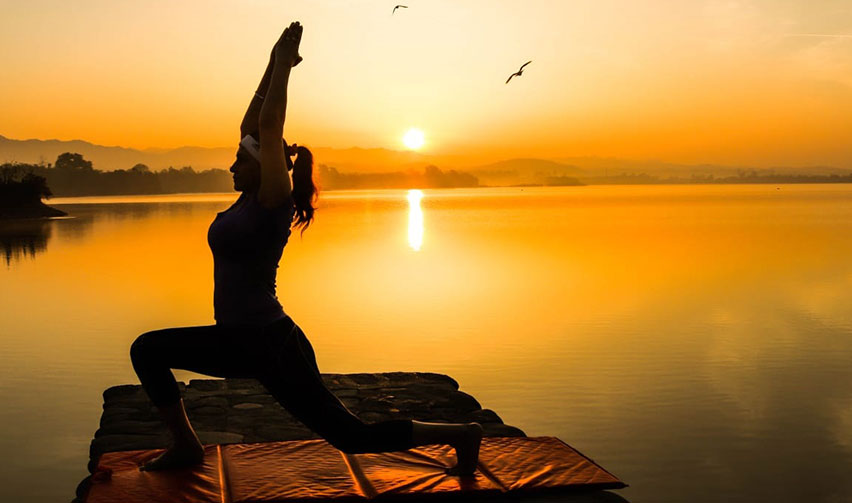
Yoga formed thousands of years ago across India, although the exact origins are unknown. Yoga is for every person in every age; therefore, Yoga keeps changing just as time keeps passing. What ancient yogis did many years ago in dark caves may not be exactly what we do today, and that’s o.k. What is significant is that there is still the essence of Yoga there.
Yoga is NOT a religion; rather, it is a discipline, one that leads to ultimate freedom.
The term “Yoga Sutra,” an Indian sage Patanjali’s 2,000-year-old treatise which is written on yogic philosophy. It helps you understand how to master the mind, control the emotions, and develop in spirit written on a guidebook. Yoga Sutras are the earliest written theory of Yoga, and one of the oldest texts in history, providing the basis for all modern Yoga.
Yoga is based on different postures and poses, but it wasn’t a crucial part of India’s original Yoga practices. A primary objective was not fitness. Instead, practitioners and adherents of yogic tradition focused on other practices, such as spreading spiritual energy through methods of breathing and mental concentration.
Each “branch” represents a different focus and set of characteristics.
This Yoga style is Known for the physical and mental branch primarily designed for the body and mind.
known for the establishment for devotion path, teaches us a positive way to channel emotions and cultivate acceptance and tolerance.
This Yoga style is Known for meditation and strict adherence to a series of disciplinary steps known as the “eight limbs” of Yoga.
This Yoga is known for the path of wisdom, the scholar, and managing the intellect in studies.
This is a service path used to create a future free from negativity and selfishness.
This is known for the pathway of ritual, ceremony, or consummation of a relationship.
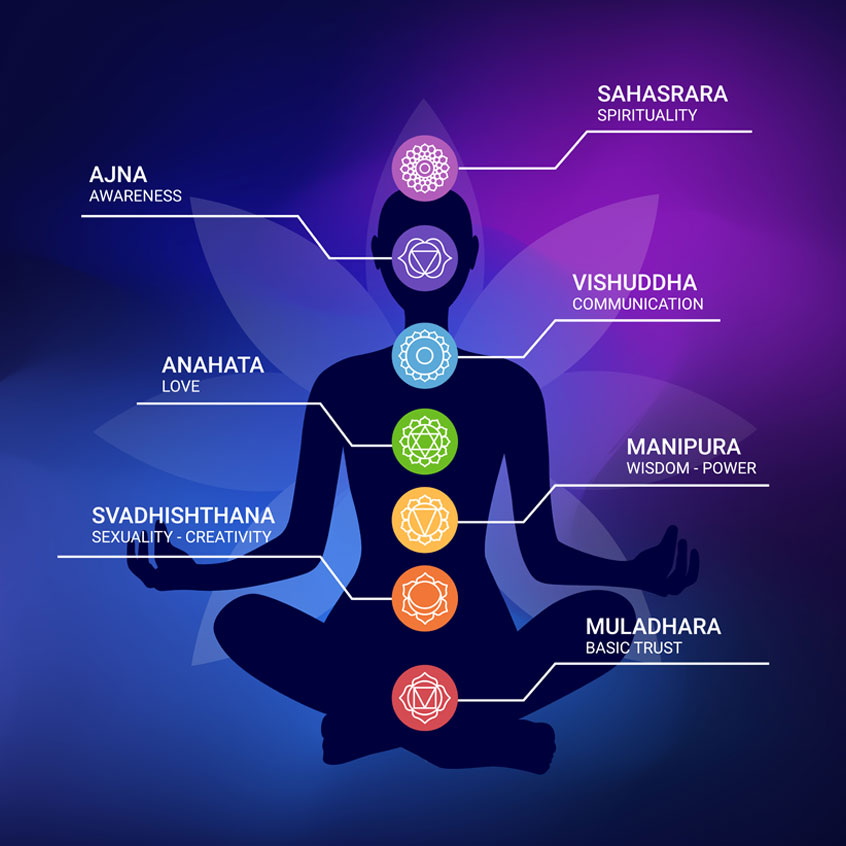
The word “chakra” literally means the spinning wheel. Yoga believes that chakras are the centrepieces of life, emotions, feelings, and the body. According to yogic teachers, the chakras decide how people perceive reality through emotional responses, desires or aversions, levels of trust or fear, and even physical signs and effects.
When energy becomes blocked in a chakra, physical, mental, or emotional imbalances are said to cause symptoms such as anxiety, lethargy, or poor digestion.
Each Chakra focuses its own ritual and rules.
The “thousand-petaled” or “crown” Chakra presents the state of pure consciousness. This Chakra is located at the head’s crown, and the color white or violet represents it. Sahasrara is all about inner wisdom and physical death.
This is “command” or “third-eye chakra.” It is a midpoint between two important energetic streams in the body. Ajna represents the colors violet, indigo, or deep blue. But the traditional yogis described it as white. The Ajna chakra is the focus of the pituitary gland, which helps in growth and development.
This Chakra is known as “especially pure” or “throat” Chakra. This represents color red or blue. This Chakra is known as the home of speech, hearing, and metabolism.
The “unstruck” or “heart” chakra. It relates to the colors green and pink. Anahata’s key issues include complex emotions, compassion, tenderness, unconditional love, equilibrium, rejection, and well-being.
“jewel city” or “navel” chakra represents with yellow color. Yoga master connects this Chakra with the digestive system. It also represents personal power, fear, anxiety, developing opinions, and tendencies towards an introverted personality.
Masters depict the “one’s own base” or “pelvic” Chakra. This is known for the reproductive organs, the genitourinary system, and the adrenal gland.
This represents “root support” or “root chakra” is at the base of the coccygeal region’s spine. This is known for our natural urges relating to food, sleep, sex, and survival and the source of avoidance and fear.
This is ancient yoga teachings. However, it became popular during the 1970s. Ashtanga yoga is put in as six established sequences of postures that rapidly link every movement to breathe.
famously name as “hot” Yoga. Bikram Yoga takes place in artificially heated rooms with temperatures of nearly 105 degrees and 40 percent humidity. It has 26 poses and following the two breathing exercises. Hatha yoga: this is a very generic term yoga gurus use for any kind of Yoga that teaches physical postures. “Hatha” yoga classes mainly represent an introduction to the basic yoga postures.
This yoga style focus on finding the correct alignment. In this yoga style, each pose work using a range of props, such as blocks, blankets, straps, chairs, and bolsters.
Jivamukti means “liberation while living.” This type emerged in 1984 and incorporated spiritual teachings. This yoga style focuses on the fast-paced flow between poses rather than the poses themselves. That’s why it is called vinyasa. In this practice, the master starts with a theme explored through yoga scripture, chanting, meditation, asana, pranayama, and music. Jivamukti yoga can be physically intense.
This yoga style teaches us, accept, and learn from the body. A pupil of Kripalu learns to find their level of practice by looking inner body. Usually, this yoga class starts with breathing exercises. There are varies exercise include gentle stretches and followed by a series of individual poses and final relaxation.
Kundalini states, “coiled, like a snake.” Kundalini yoga is known as a system of meditation that goal to release pent-up energy. This yoga exercise begins with chanting and ends with singing. Between, you also learn different asana, pranayama, and meditation in the class.
one of the popular and powerful yoga styles. In the late 1980s, practitioners created this active and athletic type of Yoga. This is based on the traditional ashtanga system.
This yoga style is a system based on a five-point philosophy. This philosophy includes proper breathing, relaxation, diet, exercise, and positive thinking to form a healthy lifestyle. Naturally uses the same 12 basic asanas work on bookended by sun salutations and savasana poses.
Viniyoga has a versatile yoga property, regardless of physical ability. Viniyoga needs in-depth learning and lots of practice.
This is known as meditative yoga practice. This is also known as Taoist Yoga. Yin yoga helps to reduce the release of tension in crucial joints, including: the ankles, knees, hips, the whole back, neck, shoulders. Yin poses are passive, meaning that gravity shoulders most of the force and effort.
This yoga style is designed mainly for pregnant women. It helps to support people in getting back into shape after pregnancy and supporting health during pregnancy.
This Yoga is also known as relaxation yoga. This yoga class includes four or five simple poses, which include use props like blankets and bolsters. It helps to dive into deep relaxation without exerting any effort in holding the pose.
Derived from the Sanskrit word yuj, Yoga means union of the individual consciousness or soul with the Universal Consciousness or Spirit.
Amanvir Kaur
Wellness Coach
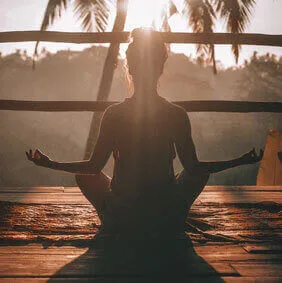
Meditation is a practice where an individual uses a technique – such as mindfulness or focusing their mind on a particular object.
Amanvir Kaur
Wellness Coach
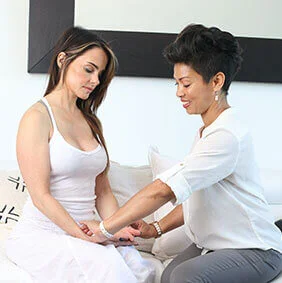
Acupressure is an alternative medicine technique similar in principle to acupuncture.
Amanvir Kaur
Wellness Coach
The coaching process addresses specific personal projects, business successes, general conditions and transitions
Amanvir Kaur
Wellness Coach